
Can I use Bathroom & Shower Cleaner on marble or natural stone?Updated 7 days ago
TL;DR: Generally yes on sealed stone, and spot test first every time. Bathroom & Shower Cleaner is mildly alkaline and non-abrasive, so it is a gentler choice on stone than the acidic descalers and limescale removers that attack calcium-based stone directly. What it cannot do is know the state of your sealer. Sealers vary by product, by installer and by age, and marble, travertine and limestone react differently from granite or engineered quartz. So the rule is the same whatever the stone: spot test a hidden patch, apply to the cloth rather than the surface, keep contact time short, rinse and dry. On anything heritage or expensive, ask the stonemason first.

Can I use Bathroom & Shower Cleaner on marble or natural stone?
✓ Generally fine on sealed stone, spot-test first
Sealed marble, granite, travertine, limestone and engineered quartz, used as directed and tested first. Bathroom & Shower Cleaner is mildly alkaline and non-abrasive. That matters because the products that damage stone in bathrooms are usually at the other end of the scale: acidic descalers, limescale removers and vinegar-based cleaners, which react with calcium-based stone directly.
The part nobody can promise you is the sealer. Sealers differ by brand, by how well they were applied and by how long ago. That is why the spot test is not a formality here, and why we would rather you did it than take our word for your particular benchtop.
Does polished stone behave differently from honed or matte?
✓ Polished stone
A polished finish is a mechanical polish, not a coating. It reflects, which is the whole point of it, and it also means any loss of gloss shows immediately and over a wide area rather than in one spot.
So on polished marble or polished granite, the thing you are watching for in the spot test is dulling, not staining. Short contact time and an immediate dry with a soft cloth is what keeps a polished surface looking the way it did.
✓ Honed, matte and leathered
A honed or matte finish has no gloss to lose, so dulling is not the risk. Residue is. Anything left on the surface sits in the texture and shows as patchiness, streaking or a water-spot pattern once it dries.
That is why the cloth-first method matters more here than anywhere. Spray onto the microfibre, wipe, rinse with a clean damp cloth, dry. Never spray a honed benchtop directly and let it pool.
Which stones need the most care?
⚠ Marble, travertine, limestone
Calcium-based, which is the whole story. These are the stones acidic cleaners react with, so a descaler, a limescale remover or anything vinegar-based is the real danger on them, not a mildly alkaline foam. Still spot test, still keep contact short, and be most careful where the stone is polished.
✓ Granite, and engineered quartz
Granite is harder and less reactive, so the sealer is the variable rather than the stone itself. Engineered quartz is a different thing again: stone particles held in a resin binder, and it is the resin that reacts rather than the stone. Most quartz brands publish an approved cleaner list, so check theirs.
⚠ Sandstone and slate
Porous, and entirely dependent on the sealer being intact. If water darkens the surface when it lands on it, the sealer is doing nothing and neither this nor any other cleaner should be going on it until it is re-sealed.
When should I skip it and use something else?
⚠ Reach for something else here
Unsealed or visibly porous stone. Splash a little water on it. If the stone darkens where the water lands and takes a while to come back, the sealer is not doing its job.
Old or worn sealers. Five years or more without re-sealing and you are working on an unknown. Get it re-sealed, then treat it as sealed stone again.
Heritage or bespoke stone. Anything irreplaceable, anything you would be devastated to mark. Ask the stonemason or supplier what they approve, and use that.
Any published care list that excludes it. If the benchtop manufacturer or the sealer manufacturer names what may be used, they win. They know what is under the finish and we do not.
In all four cases, plain water on a soft microfibre is a perfectly good weekly clean, and a cleaner your stone supplier approves is the right step up. Keep Bathroom & Shower Cleaner for the tiles, glass, grout and fixtures around the stone instead.
How do I spot test, and what is the method after that?
✓ Four-step spot test
Pick somewhere nobody looks. A corner tile, under a basin lip, the back edge of a benchtop. Somewhere you would not mind if the test went badly.
Spray, wait 60 seconds, rub gently. Sixty seconds and no longer. Soft microfibre only, light pressure, nothing abrasive.
Rinse, dry, then look properly. Water rinse, clean dry cloth, then check under good light for dulling, discolouration, etching or a change in texture.
Check again after 24 hours. Some reactions take their time. If the patch still matches the stone around it a day later, you are clear.
✓ The method once it passes
Spray the cloth, not the stone. That controls how much goes on and stops it pooling in grout lines or in the texture of a honed finish.
Wipe gently. Light pressure, soft microfibre. No pads, no scouring, no scrubbing at a mark that will not shift.
Rinse with a clean damp cloth. Water only. Get the residue off before it dries, which is the whole game on honed and matte finishes.
Dry immediately. Soft dry cloth. Do not let water sit on stone or pool along grout lines. On a sealed stone shower wall, a quick spray and rinse weekly is fine, but benchtops are always cloth-first.
GECA certified, Sensitive Choice approved, Dermatest tested, Eczema Association recognised. Made in Australia.
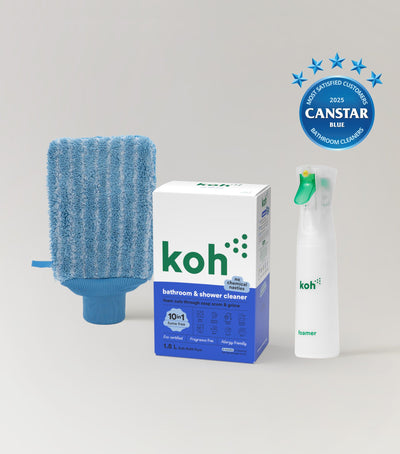
Bathroom & Shower Cleaner, Ultra Pro Bathroom Mitt and Foaming Spray Bottle. New to Koh, this is the one to start on.

Koh Perks · earn points on every order
Earn points on every purchase, refer a friend, and redeem for discounts on your next order.
Browse all Bathroom & Shower Cleaner articles
Last reviewed: September 2026 · Koh Australia