
Is Kitchen Grease & Oil Cleaner suitable for stone benchtops?Updated 21 days ago
TL;DR: Kitchen Grease & Oil Cleaner suits sealed stone benchtops, including engineered quartz such as Caesarstone, Silestone and Quantum Quartz, plus sealed granite and sealed slate. Keep it off marble, limestone, travertine and polished stone. Those four want a pH-neutral stone cleaner instead. For any other natural stone, the answer comes down to your sealer and finish, so spot-test before you use it all over.
Can I use it on stone benchtops?
✓ Suitable
Sealed stone benchtops handle Kitchen Grease & Oil Cleaner well. Modern engineered stone and sealed surfaces are not troubled by a pH 8.5 cleaner that rinses clean.
⚠ Use a stone cleaner instead
Marble, limestone, travertine and polished stone want a pH-neutral stone-specific cleaner. The reason is in the next section.
⚠ Spot-test first
For other natural stone, the answer comes down to your particular sealer and finish. Run the four-step test below before regular use.
✓ After you clean
Rinse the benchtop with clean water and dry it. Kitchen Grease & Oil Cleaner isn't food grade, so rinse any surface that food touches with clean water afterwards. If you are not sure what stone you have, your stone supplier or installer can tell you, and they will also know what sealer is on it.
Why avoid marble, limestone, travertine and polished stone?
Kitchen Grease & Oil Cleaner is alkaline at pH 8.5, not acidic, so acid etching is not what happens here. The risk on marble, limestone, travertine and polished stone is a different one.
⚠ What is actually at risk
Those four stones are soft, porous and calcium-rich. What keeps them looking right is an impregnating sealer with a polished surface over the top.
A degreaser is built to strip oil, and repeated use works against a sealer of that kind. Once the sealer thins, the stone takes up stains more readily and the polish goes flat.
✓ Why sealed engineered stone is different
Engineered quartz is a dense composite with the pigment and resin bound through the slab rather than sitting in a surface layer. There is no impregnating sealer doing the work, so a pH 8.5 cleaner that rinses clean has nothing to strip.
✓ What to use on those four instead
A pH-neutral stone-specific cleaner. Your stone supplier or installer will usually recommend one for the sealer they used. Neither dulling nor a thinned sealer reverses on its own, so this is worth getting right before the first clean rather than after.
How do I spot-test before using it?
✓ Four steps
Apply. Put a small amount on an inconspicuous area. The back corner, an installation offcut, or a hidden underside all work.
Wait. Leave it on the surface for about a minute.
Rinse and dry. Wipe and rinse thoroughly with clean water, then dry with a soft cloth.
Check carefully. Look for dulling, discolouration, etching or any other change, in good natural light. No change means the cleaner suits your surface. Any change means use a pH-neutral stone-specific cleaner instead.
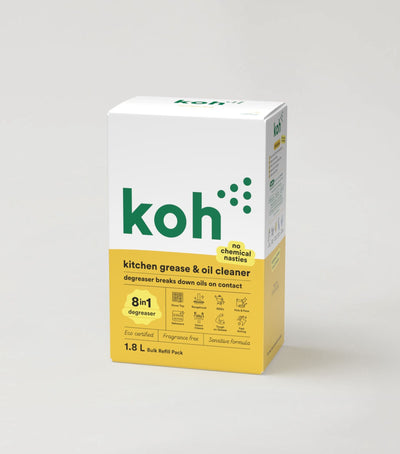
pH 8.5, alkaline. 15 ingredients, two enzymes. Lasts an average home around 6 months. GECA (Good Environmental Choice Australia) certified, Sensitive Choice approved, Dermatest tested, Eczema Association of Australasia recognised. Made in Australia.
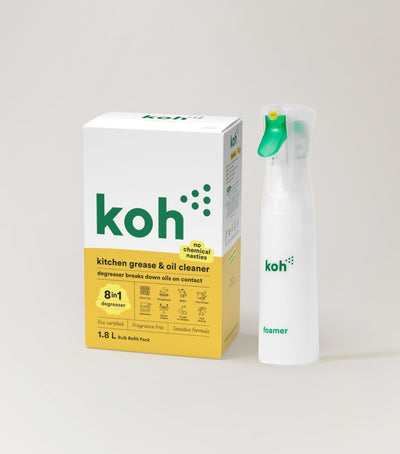
Kitchen Grease & Oil Cleaner Starter Kit · new at Koh?
Pairs Kitchen Grease & Oil Cleaner with a Foaming Spray Bottle. Spray the foam on, give it a few minutes, scrub, rinse.

Koh Perks · earn points on every order
Earn points on every purchase, refer a friend, and redeem for discounts on your next order. Every way to save sits in one place.
Browse all Kitchen Grease & Oil articles
Last reviewed: September 2026 · Koh Australia